0

Unpronounceable Entrées and the Ethics of Cake Destruction

Four Courses Podcast - Episode 16

Sppppprrrrrinnnnnnng! Once the weather lightens up, there's so much more to get out and do, food-wise. OK, everything-wise, but that's not what we're about. Want to know what we are about? Then click over to Four Courses and listen to Episode 16!


Topics include Yemanja Brasil, the Spring edition of "Our Favorite Drinks", the shoddy reputation of wedding food, and a very careful chat about how one should tip when there isn't a server in play. We go out on a Sell Me On... segment in which the herbs of the season are passionately advocated for. Enjoy!
0

Summer Movie Preview: May 2015

Let's try something a little different this year. Let's sort the movies that Entertainment Weekly has published in their annual Summer Movie Preview into categories. I love calendars and everything, but I should really feature the things that have most caught my attention. So, since the summer movie season starts earlier these days, let's begin with May!

The Main Attraction: Oh, this one's easy. May's tentpole is going to be Avengers: Age of Ultron (May 1). I'm not in love with every Marvel movie, but I did really like the first Avengers, and I trust Joss Whedon. I've managed to keep myself in the dark as far as plot and everything (I haven't even seen the trailer), so I'm very much looking forward to seeing if this one can keep up the high expectations I have for this series.

Looks Promising: I'm always up for a good disaster movie, and San Andreas (May 29) looks like it'll fit the bill just fine. There's also Brad Bird's Tomorrowland (May 22), a futuristic sci-fi which looks about fifty kinds of intriguing.


Possible Rental: If I can go with the Rum Crowd, I might consent to see Pitch Perfect 2 (May 15), but if not, that's a clear wait-for-Netflix title. The first one didn't wow me.

We'll See: Low on the radar, but at least present. There's a period drama (Far From the Madding Crowd - May 1), a buddy comedy with Reese Witherspoon and Sofia Vergara (Hot Pursuit - May 8), and a Kristin Wiig movie in which she plays a woman with a borderline personality who wins the lottery (Welcome to Me - May 1).
0

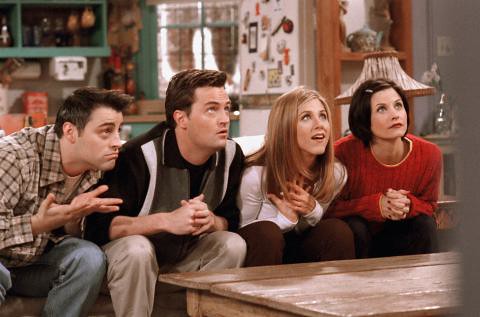
The Rewatch: Friends - Season 4

Well, this is surprising. I usually assume that seasons of scripted television will follow one of two pretty predictable patterns: Either they'll start out great and get incrementally worse as time passes (Heroes), or as is more common, they'll form a bell curve by starting out OK, becoming great somewhere in the middle, and then declining (30 Rock). Friends refuses to follow these trends. Maybe I'll put my mad phat scientific skillz to use at the end of this Rewatch and do a line graph to see if any sort of pattern emerges, but for right now, it's all over the damn place. All this to say that Season 1 was pretty great, Seasons 2 and 3 dipped into less-than-good, and here we are at Season 4, which is, in a word, terrific.

I have no idea how they accomplished this sudden spike. Did they get new writers or something? How on Earth did they go from Mopey Possessive Ross to Charming Hapless Ross so fast? How did they deepen the friendships between the central characters without getting all syrupy about it? How did they incorporate pregnancy in a way that wasn't instant comedy death? Whatever animal sacrifice the producers made to the pagan gods of their choice, it was worth it, because Season 4 was firing on all cylinders.

In this one batch of episodes, we get a ton of the bits that Friends fans cite as the show's most classic scenes: Chandler trying to quit the gym, Ross trying to date a girl who lives too far away, the sudden appearance of free porn on Chandler and Joey's television, Monica getting mocked for dating Richard's son and immediately dishing out some mockery of her own, Phoebe's agonizing over what name to choose for one of her brother's babies, etc. etc. You'd think, given that this season was so good, that choosing the best episode would be difficult, but even with all that's wonderful about Season 4, one episode effortlessly rises to the top (see below).


No season is perfect, of course. I like Friends the least when it indulges in its schmoopy, accelerated love stories. Within a few weeks in the show's universe, Kathy is Joey's girlfriend, Chandler's soulmate, and a cheating shrew in rapid succession. Ross and Emily's relationship is even speedier; the Japanese maglev train would take a look at how fast Ross and Emily go from meeting to wedding altar and be like "Whoa, settle down, crazypants."

But for the most part, there just isn't much to complain about, here. Emily was a worthy obstacle to the show's Grand Romance, the show indulges in some fun meta-humor by having audience-surrogate Hugh Laurie tell Rachel just how awful her motivations are, and did I mention Monica's five seconds of mockery? I did? Well, here. Watch it now. And I haven't even mentioned the season's pinnacle yet.

Notable Guest Stars: I have a confession to make: Until the Rewatch, I was 85% sure that Emily was played by Emily Mortimer. Not so! Emily is played by Mortimer's doppelganger, Helen Baxendale, who actually sells her whirlwind romance with Ross, so good for her. Paget Brewster, who is absolutely killing it these days on Community, is also a welcome presence as Kathy, the girl who comes between Joey and Chandler. Tate Donovan is fairly milquetoast as Joshua, but that's not really his fault (see below). Other flashes of star you'll see this season include Michael Vartan, Olivia Williams, Rebecca Romijn, Jennifer Saunders, and even Fergie (the original one).

What's Keeping Ross and Rachel And Their Apparently Greatest Love in the History of the Earth Apart This Time: Oh, so much! You might remember Ross having to choose between Rachel and Bonnie at the end of Season 3. He chooses Rachel, but their happy reunion is brief, as Ross falls asleep while reading a letter from Rachel asking him to shoulder the blame for everything that went wrong in their relationship. When he realizes it, he blows up, and they're kaput again. For now. Sigh. The two go their separate ways, Ross to Emily, and Rachel to Joshua. As I've mentioned, the Ross/Emily thing moved too fast (so fast I believe Rachel's last name is misspelled on the wedding invitation - YOU HEARD IT HERE, FIRST), but it was at least well-developed. Joshua is a non-entity. A bland hunk - hey, just like Mark! - for Rachel to crush on, successfully land, then drive away with a bit of patented Rachel Green lunacy. We end the season Ross accidentally saying Rachel's name at the altar, so I guess the Grand Romance Cliffhanger is officially a trend? Boooo.

Best Episode: Easiest choice ever. I haven't mentioned it yet, but far and away, it's "TOW the Embryos", which is not only the best of the season, but will be a strong contender for best episode of the entire series. It's got a misleading title, because while Phoebe and her brother's embryos do take up a chunk of running time, this one is really TOW the Trivia Game. Monica/Rachel and Joey/Chandler make increasingly high bets over which pair know each other better, resulting in the trivia game where the winner will either have to give up their pet birds or give up the huge, rent-controlled apartment. Ross plays game show host to the hilt, and the entire sequence is a perfect summation of these characters' personalities.

Worst Episode: It would be difficult to choose an out-and-out terrible one, since this season was so great, overall. Luckily, "TOW the Invitation" sticks out like a sore thumb, combining the fact that it's a clip show with the fact that it's a clip show devoted entirely to Ross and Rachel And Their Apparently Greatest Love in the History of the Earth. Bleh.

Now comes the big question: Will Season 5 be a continuation of the high quality that Season 4 exemplified, or will it sag back into the disappointment that Season 3 brought? I'm hoping it's the former, but there's only one way to find out! Onward!
0

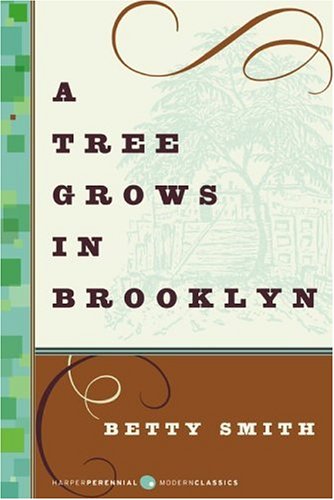
Pop Culture Homework Assignment #13: A Tree Grows in Brooklyn

I'm curious about the process by which we've decided which books are taught in high school English. I'm sure the teacher has some input, but from what I've heard, there isn't a lot of variability. When I tell people about the essays I had to write about The Scarlet Letter and Animal Farm, I can be reasonably sure of a sympathetic audience that had to go through the same thing. Once I graduated, it occurred to me that while Parkway South gave me a perfectly decent education, I should seek out books considered classics that I never got around to in the classroom. It's kind of the whole point of the Pop Culture Homework Project!

By doing this, I've discovered books that are wild, books that are wonderful, and books that are disappointing. But so far, I haven't caught up with a book that has really taken my breath away. Until now!

When Betty Smith's novel, A Tree Grows in Brooklyn, was published in 1943, it was an immediate best seller. Since then, it's been adapted into a movie (1945), a Broadway musical (1951), and a made-for-TV movie (1974). And I knew absolutely nothing about it but the title. The book begins in 1912, and revolves around Francie Nolan, who at the beginning of the story is an eleven-year-old girl living in the Williamsburg section of Brooklyn, New York. Nowadays, we think of Williamsburg as a cradle of wealthy hipsters and helicopter parents, but in 1912, it was stacked with tenement houses for the city's poor. The Nolans are among these poor, and while they aspire to a better life, they often go to bed with empty bellies.


It's tough to describe the "plot" of this novel, because it's a slice-of-life book. It may sound boring to hear that it deals with Francie's efforts to deal with events as everyday as trying to win a prize from the local candy store or how terrible her uncle is at relating to his horse. But just as the lives lived in The Up Series are about a collection of the little things, rather than just reporting on the highlights and lowlights, this book is much more than the sum of its parts.

Clearly, it's very autobiographical, but by making it fictional, Smith was able to get into more characters' heads than just Francie's. Everyone in the family is a well-rounded character, from her no-nonsense mother to her remorseful, alcoholic father to the kind, slutty aunt desperate for a child to raise. Nobody is wholly good or wholly bad. They're, you know, human. The book speaks frankly about Francie's romantic and sexual curiosity, something I found pretty shocking for a book written in the '40s.

Despite its slow pace, I couldn't put this book down; it's easy to see why it caught on with the public so quickly. Francie is enchanting in her normalcy, and the book she inhabits is rich and evocative. Far from romanticizing poverty like SOME things I could mention, the novel deals with the Nolans' money woes practically, without ever becoming a depressing slog.

So, it's time for a shake-up in American high school English classes. Teachers, take note. Why not teach this hopeful-yet-realistic novel that encompasses themes from poverty to the challenges of public education to economic exploitation to love? It's a hell of a lot better than that Heart of Darknesss crap.

A Tree Grows in Brooklyn: A
0

Knowledge is Power!

In my post about Cosmos, I hearkened back to my love of shows that managed to be the perfect blend of fun and education. It made me sad, even as I was watching something so wonderful, to think that there's a real dearth of these kinds of shows today.

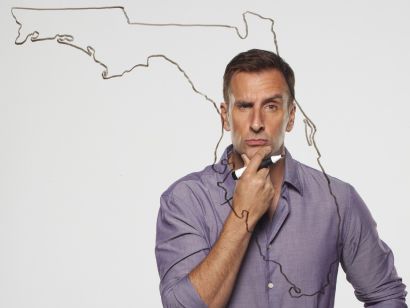
Fortunately, my melancholy was temporary, and it didn't take long for me to stumble over a pair of shows that offer the same edutainment blend to my adult brain that good ol' Square One TV offered Kid Me back in the day. The first was How the States Got Their Shapes, which airs (aired?) on the History Channel. I own the book the TV series is based on, which is fantastic. Written by Mark Stein, it delves into the stories, fights, laws, and compromises that shaped the lines we take for granted on our maps today. I figured the show would just be a visual presentation of the book's facts, and I've never been happier to be so wrong.

The shows goes in an entirely new direction. Host Brian Unger traveled to all fifty states and interviewed their citizens, talking about everything from accents to political leanings to driving habits to diet to a million other things. The book may have explained how the line between Missouri and Kansas got drawn, but the show goes into the fierce sports rivalry that developed because of it. It's pretty damned interesting.

I'm only through Season 1 so far, but am looking forward to binge-watching Season 2. Those episodes originally aired in 2012, and there haven't been any since, but nobody has ever said that it's officially canceled, so maybe someday, we'll get more. In the meantime, though, how will I keep my brain occupied?


Oh, I know! By pummeling it with tricks, illusions, and psychological fake-outs. Quick: Is this dancer spinning clockwise or counter-clockwise? Well, both. It all depends in how you look at her! I've loved optical illusions and logic puzzles since I was a kid, so imagine my delight when Netflix saw that I was watching How the States Got Their Shapes, and suggested that I might like Brain Games, which airs on the Nat Geo Channel.

The first two seasons are available to stream, and I tore through them. The first three episodes are long and narrated by Neil Patrick Harris. From there, the show shifted into a shorter format, and took on Jason Silva as a host, instead. They demonstrate and discuss all of my favorite tricks of the brain, and happily, have introduced me to a few new ones, too. It's so wild to see just how easily your brain can be misled, and delving into the science of why that may be is utterly fascinating. I've been poking into Season 3 on YouTube, and unfortunately, the quality of this show may be dropping off. But for the purposes of this review, I'm just focusing on the two streaming seasons, and if you're a nerd like me, you'll be delighted by the answer to why kids almost instantly know which direction this bus is traveling, while adults struggle with it. Gotta love our weird-ass brains.

How the States Got Their Shapes - Season 1: B+
Brain Games - Seasons 1 & 2: A-
0

Cult of Personality

Like a lot of people in mainstream society, most of what I knew about Scientology was limited to recent headlines about their abuses. I knew about its founding by a science-fiction writer, I knew about its high-profile celebrity members, and I knew that it's anti-psychiatry, anti-gay, and that it bleeds its members dry financially. But that's about it. So, I had two big questions going into Alex Gibney's documentary, Going Clear: Scientology and the Prison of Belief (based on a book by Lawrence Wright). Why do people join this organization and stay in it? Why does Scientology get beat up for having all these wild and wacky beliefs, while other religions get a pass on having equally improbable assertions?

These questions are addressed in the movie, but only briefly. Basically, people join because it seems like a decent method of effecting positive change in the world and of self-improvement. Dissatisfied members stay because if they leave, there's a good chance that their family and friends will "disassociate" from them, and they'll lose their entire support system. As to the second question, it's true that other organized religions certainly have their problems, but there are two important distinctions:

1) Other religions are religions because they have actual belief systems; they didn't become religions just to avoid paying taxes.

2) Other religions lay out their rules and rituals up front and at no cost. You can be a Muslim or a Christian or Jew without giving a dime to anyone, and you'll have full access to all of the information about what your beliefs entail, according to the organization. In Scientology, you have to earn knowledge. And you earn it by giving them money.

The great majority of the movie's running time is spent on exposing just how corrosive the Church of Scientology is to its members, its ex-members, and its critics. So, I guess it says something that even though my questions weren't given enough attention, I was still riveted and horrified.


The interviews given in this movie are not from casual ex-members of Scientology. These people attained high levels of power within the church. They know what they're talking about, and the stories they tell, from losing their family members to disassociation, to shocking tales of physical abuse and neglect, to the harassment and stalking they endured when they finally broke free are infuriating. How can you tell this information is reliable? How about the more than 100 lawyers that reviewed everything presented, to make sure the filmmakers would be insulated from the notoriously litigious church?

Going Clear also takes Scientology's celebrity spokesmen to task, suggesting that John Travolta and Tom Cruise could save a lot of lives from being ruined if they would stop shilling for Scientology, but that they're too enamored of the perks that the church lavishes upon them. A lot of disgust is also understandably directed at the IRS, who waved the white flag about allowing Scientology tax-exempt status, basically because they were incredibly lazy and wanted to avoid a hassle in the courts.

As I get older, I'm becoming increasingly impatient with the behavior of organized religions. But the one thing I can allow for even the most violent and bigoted Christians and Muslims is that at least they believe in their convictions. It doesn't excuse their actions, but it helps explain them. When it comes to Scientology, Going Clear makes it plain that its motivations are money and power. As a movie, it's nothing extraordinary. But as evidence that the practices of Scientology are a problem that society can and should solve, it's essential.

Going Clear: Scientology and the Prison of Belief: B+
0

Stand By Your Man

The split referenced in the title of A Separation happens right up front in the opening frames, but turns out to be just the first little domino that sets off a very sad chain of events. The dissolution of a marriage is actually the problem with the lowest stakes. Simin initiates the divorce because her husband Nader refuses to move with her and their daughter Termeh out of Iran because Nader insists on staying to care for his father, who is suffering from Alzheimer's. Simin remains in town, but does move out of the family home, forcing Nader to hire a caretaker for his father while he's away at work. And that's where the real trouble begins.

I won't give away everything that happens, because I want to encourage people to see this movie. But I will say that grudges soon develop between Nader and the caretaker (Razieh), drawing both of their families into an escalating web of accusations and consequences.


This movie won the Oscar for Best Foreign Language Film for 2011, and it's not hard to understand why. It comments on so many aspects of Iranian culture, from religion to gender roles to health care to the justice system, and handles them all with aplomb. It is decidedly not a joyful romp; each and every character is really put through the wringer. But there's no denying that it's a riveting story, and contains some really haunting performances.

I often skip a lot of acclaimed foreign movies, not because I'm fiercely protective of American cinema, but because it often seems like the only movies to make their way here from other shores are in some sort of competition to see who can be the most hopeless and bleak. While A Separation certainly trades in unhappiness, it does so in a way that fascinates, rather than repels. While it may have been a difficult watch, it was definitely a worthwhile one.

A Separation: B+
0

Pulling the Plug

When I reach the end of a television season, I write a review of it. Simple, right? But there's a category of TV that has fallen through the cracks: The flame-outs. I'm already doing this for books, so why not mention the TV shows that will not be getting a grade? Even a bad one! Maybe these shows aren't canceled in the official sense, but when it comes to my personal TV schedule, they've been yanked. Now that I've established the premise, I'll completely ignore it, and open with an exception to the rule:

The Show: The Suze Orman Show
The Pitch: A talk show about financial advice
How Far Into It I Got: The show had more than 600 episodes, and while I wasn't a regular viewer, I liked to check in with it pretty often, even if it was by listening to it in podcast form during my commute.
What Went Wrong: Nothing. The series ended this past week. Orman could sometimes get on my nerves, focusing more on psychology than the money advice people were calling in for. In general, though, I enjoyed her and the show's format, and can't deny that I picked up very useful tips. I'll definitely be checking out her new show when it rolls around.

OK, so like I said, that's more of an exception, because it's a show that ended naturally. On to the more...abrupt finales.

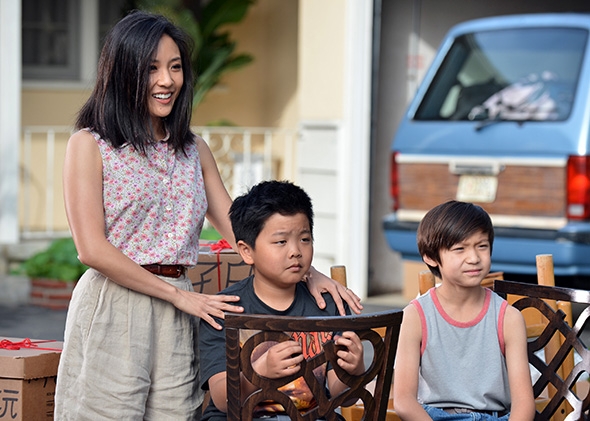
The Show: Fresh Off the Boat
The Pitch: A comedy about a Taiwanese family trying to make their way in America during the 1990s.
How Far Into It I Got: Season 1, Episode 8
What Went Wrong: The show's got some good heart to it, and has actively made me laugh out loud more than once. 98% of those laughs come from Constance Wu (as fierce, no-nonsense mother Jessica). Two major strikes have taken it down, though. I don't want to suggest that all comedies starring non-white actors are ripe for comparison, because they're not. But all of the how-do-we-fit-into-society jokes this show and Black-ish strive for are virtually identical in terms of tone and cadence, and Black-ish does it so, so much better. Plus, and it brings me no joy to say this, the show centers around Hudson Yang, whose performance is gratingly obnoxious.


The Show: The Last Man on Earth
The Pitch: A Will Forte comedy about a man who believes he is the sole human remaining, and how he handles things when the people he so desperately wished to see finally show up and aren't what he imagined.
How Far Into It I Got: Five minutes into Season 1, Episode 8
What Went Wrong: Oh my God, this had such promise. The first few episodes were terrific. Forte plays Phil Miller who has all the fun that can be wrought out of living in a consequence-free world, and only wants company. When his wish is granted in the form of Carol (Kristen Schaal), a ton of comedy is mined from the fact that they could not be more ill-suited for each other. Even more possibilities are opened up when beautiful Melissa (January Jones) shows up, shortly followed by nice-guy Todd (Mel Rodriguez). So what did they do with these possibilities? They turned Phil into the biggest asshole in the world. It started as a daring show about the absurd rules and compromises we'd make if society as we knew it vanished. It then abruptly shifted into a hacky, mean-dumb-guy-gets-his-comeuppance cringe comedy. After three episodes of our "hero" being an insane twat, learning his lesson, then reverting to being an insane twat, I gave up.
0

Author! Author!

As much as I aspire to judge everything I read on its individual merit, I'm always forced to start a new book with preconceptions about the author (I mean, assuming I've already read any of their previous books). Sometimes, I'll allow critical praise or recommendations to overpower my suspicions about a book by an author I don't generally like. Sometimes, I willingly pick up a book that has an off-putting premise just because I've enjoyed the writer's other work. This method doesn't always work out. But there have been pleasant surprises, too.

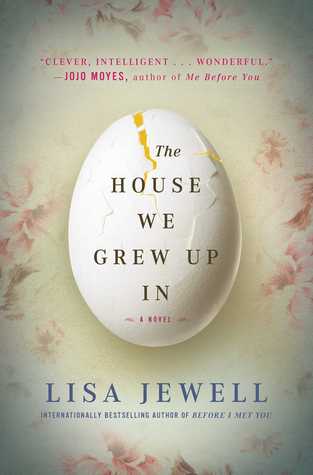
I got the opportunity to test this on both levels recently by reading Tom Perrotta's 2013 book of short stories (Nine Inches) and Lisa Jewell's 2014 novel (The House We Grew Up In). Let's get this out of the way: I think Tom Perrotta is a very talented, capable writer...whose books I don't like. I'm in the minority on this one; everyone else I've talked to about Perrotta really loves him, but his writing just keeps striking me as Diet George Saunders. Meanwhile, I've really liked (most) everything I've read by Lisa Jewell. It all took place before this blog was started, but Ralph's Party and One-Hit Wonder were great! OK, so Thirtynothing wasn't my favorite, but she's still got a good track record as far as I'm concerned. So, I snagged Nine Inches on a friend's recommendation, despite some reservations. And I snagged The House We Grew Up In based on not much more than residual affection for the author. How did it go?


Well, it went about how you'd expect. Nine Inches is a perfectly well-written collection of stories that I wound up not liking very much, and The House We Grew Up In gripped me from the start. Nine Inches has a lot of Perrotta hallmarks. That is to say, the stories are mostly about families being ripped apart, the regrets we have in old age, and aimless teenagers wrestling with having no real sense of identity. Like The Leftovers, there doesn't seem to be any resolution (either positive or negative) to the characters' despair, and perhaps that's the point. So I'll just paraphrase a statement I read from a person much wiser than I: I feel about reading Tom Perrotta books the way I feel about the World Cup. I'm glad it's successful, and I'm thrilled you like it, but I'm going to be over here doing something else.

The House We Grew Up In fared much better. It's about the seemingly perfect Bird family in a small English town. They've got a loving household, and the family is tightly-knit, always finding time to mark special occasions, especially Easter. But when tragedy strikes, the family begins to crumble, thanks in large part to the mother (Lorelei) giving in to her hoarding tendencies. The remaining family members react in wildly varying ways. Beth remains at home and hopes for the best, giving up any expectation of a normal life. Rory bolts, trying to grab at as many life experiences as he can. Meg swings the pendulum hard in the other direction, not allowing a single speck of dust or useless clutter to cross her doorstep.

The family makes an effort to stay somewhat tethered to each other and to offer emotional support to the mother that won't admit to the mental illness she clearly suffers from. It's a tough road, though, and each of the family members has their own issues to work through as well. Hoarding has always been a fascinating topic to me, and makes a terrific premise to center a novel around. Jewell writes with her usual wit and relatability, and I tore through the book in no time flat.

So, maybe objectivity isn't all it's cracked up to be. While I'm still open to being disappointed by an author I enjoy or happily surprised by an author I tend to dislike, these two books reinforce that my favorites are my favorites for a reason.

Nine Inches: C+
The House We Grew Up In: B+
0

Meals on Wheels

I always like it when the entertainment world encompasses my equally fierce love of the food world. Or at least, I like it when they do it competently. Just cause something has to do with food or cooking is no guarantee that I'll be automatically on board. I didn't worry too much when it came Chef, though. Chef is a 2014 movie written by, directed by, and starring Jon Favreau. Clearly, he felt pretty strongly about the material. It got mostly good reviews and came highly recommended by friend-and-cohost Kyle, so I was fairly certain I was in good hands.

Chef revolves around the story of Carl Casper (Favreau), a chef who has found a large measure of success at an LA restaurant, but in exchange for that success, he's given up his opportunities for creativity and personality in his menus. An acidic critic (Oliver Platt) calls him out on this, leading to a Twitter war and Casper's eventual joblessness. Casper resolves to re-discover why he became a chef, and with the help of his still-amiable ex-wife (Sofia Vergara) and sous chef (John Leguizamo), starts a cross-country trip on a food truck. The trip is his chance to not only re-ignite his career, but to forge a stronger connection with his son (Emjay Anthony), whom he's often neglected.


The movie has a lot of themes on its mind. Obviously, the importance of maintaining relationships with friends and family is the big one. No man is an island, and Chef tackles this not only by addressing Casper's attempts to make up for his disappointing parenting, but by pointing out to him that he can't accept the accolades and success for running a popular restaurant without also accepting its limitations. In order to express himself artistically, he must strike out on his own.

The movie also takes on the often-tired trope of criticism, and frankly does a better job of it than Best Picture winner Birdman. Caspar attacks Platt's character for glibly shitting all over his life's work, but the movie balances that out by admitting that Platt's review was entirely correct; Casper really has lost his way.

Not everything in the movie works. The relationship hurdles it sets up are cleared too easily. It's got a very odd view of social media, in which a taco truck cruising through town causes more online enthusiasm than it would if it were Beyonce. The story is also based on the life and work of Roy Choi, who we've met before, and who is, not to put too fine a point on it, kind of an egotistical ass.

Overall, though, it was a very enjoyable movie, and not just from a story perspective. It's got some great music, and the beauty shots of the food are incredible. If Chef accomplishes nothing else, it'll have you running for the refrigerator in no time.

Chef: B
 
Copyright © Slice of Lime