Showing posts with label Pop Culture Homework Project. Show all posts
0

Pop Culture Homework Assignment #16: Logan's Run

The Pop Culture Homework Project has brought to light an interesting conundrum: Is there an invisible expiration date on properties that were popular either at the time they were released, or developed a cult following later? Where's the magical line between good, bad, and so-bad-it's-good? The benchmark for this question appears to be The Goonies. Like most people who really enjoyed that movie, I saw it as a kid, and was enraptured by the adventure, the Rube Goldbergian booby traps, and the youthful snark. Sometimes, though, I'll run across someone who dislikes the movie, and my first question to them is always the same: "How old were you when you first saw it?" And without fail, the naysayers saw it when they were already in their late teens or beyond, and saw it in the modern age (that is to say, they saw it at least ten years after its release in 1985).

It feels like whatever personality trait that was endemic to the target audience of the time has somewhat evaporated, and it becomes a kind of you-just-had-to-be-there experience. I ask all this because I just saw the 1976 sci-fi classic, Logan's Run, and am completely befuddled by its reputation. I knew going in that it was about a futuristic society in which nobody is allowed to live past the age of 30, that it starred Michael York, and that it was about someone trying to escape the fate signaled by the flashing red crystal embedded in their palm. That's about it.

Now I can fill in the gaps. Sort of. York plays Logan, a "sandman" who's in charge of exterminating any citizen who attempts to weasel out of their scheduled death. For a society portrayed as a utopia, there's a lot of these runners. He enjoys his job, but things become complicated when his bosses decide he's to go undercover as a runner to infiltrate Sanctuary, a hidden conclave of people who are unaccounted for. Logan befriends reluctant prostitute Jessica, correctly suspecting that she knows something, and the two of them begin the search for Sanctuary, learning uncomfortable truths about their society in the process.


So. Why is this thing so well-regarded? I love Michael York, but even he can't escape the hamfest of acting this movie contains. Everyone's at an eleven all the time. I can accept that special effects in the 1970s are going to look goofy, but it'd have been nice to have even a speck of subtlety in any of the performances (Farrah Fawcett-Majors being the most cringeworthy - I know she was likely cast to be eye candy, but yikes).

The plot is a mess, too. The citizens of this society don't do anything but walk around in large atria, giggling to each other. The sandmen ruthlessly track runners, but see no need to clamp down on the Cubs, the one "dangerous" element of society ("dangerous" is in sarcastic quotes, because the Cubs are about as intimidating as a Hello Kitty plush doll). Two of Jessica's friends plot to murder Logan, but their characters disappear midway through the movie, never to be seen again. And the ending suggests some sort of radical shift in how society functions, but gives no clue as to how that will come about or what it might be.

I do have to admit that even with all this complaining, Logan's Run was a lot of fun to watch; especially since I was watching it with friends, and we MST3K'ed our way through the whole thing. It just brought up so many questions. Was this laughably cheesy even at the time, or did people really enjoy it as pure sci-fi? Why has it endured all these years? And if ever there was a property ripe for reboot, this would be it. How come there hasn't been a modern remake? Oh, well. I guess we'll put all those questions in the same pile as "So what the fuck was that ice cave robot scene, and what was it meant to accomplish?"

Logan's Run: C
0

Pop Culture Homework Assignment #15: Around the World in 80 Days

I've been enjoying the Pop Culture Homework Project, but once in a while, it reveals to me that I've missed my window. Catching up on books like A Tree Grows in Brooklyn and Wuthering Heights long after everyone else has read them was fine, because those books don't really have a narrow target audience, age-wise. But when it comes to books like A Wrinkle In Time, I just can't experience the way I'm supposed to, as an innocent child.

And now, I'm afraid, the same goes for Jules Verne's 1873 classic, Around the World in 80 Days. Even finding a complete and unabridged copy of this novel was a challenge. Every time I thought I had found it at the library, it turned out to be a picture book or an adaptation for kids, with dumbed-down vocab and words printed as big as bagels. Finally, I was hanging out with a friend one night, and noticed an unabridged copy sitting on his bookshelf. Fortuitous!

As you no doubt know, Around the World in 80 Days centers around one Mr. Phileas Fogg, a very wealthy man living in London, who bets the other members of his gentleman's club that he can circle the globe in the titular timeframe. This was nearly impossible in the late 1800s, and for him to make it, every single thing must go right for him; a single and minor delay will put him irrevocably out of the running. His entire fortune, not to mention his reputation, rests on this wager.

The laconic Fogg drags his new manservant Passepartout along on the journey, meeting a lovely and helpless woman (Aouda) during their travels. After saving her from being sacrificed in a ritual she also joins them. The group is being pursued by the detective Fix, who is convinced that Fogg is financing his trip with ill-gotten money he has stolen from a bank. He longs to arrest Fogg, and awaits the legal warrant to do so as he follows them from country to country.


Sounds like a thrilling adventure, doesn't it? Unfortunately, almost all the barriers to Fogg's success (and there are many) melt away for one single reason: Money. People not moving in enough of a hurry? Fogg throws money at them, and they speed right up. No means of conveyance available other than an elephant the owner doesn't want to part with? Fogg throws money at it, and the elephant is his. Captain of a ship not willing to deviate his route to help out? Fogg throws money at it, buys the ship and the crew's help, and gets back on track. Money, money, money. It's kind of boring.

Add to this some strange writing quirks (Aouda falling in love with Fogg for no real reason, an off-page rescue of Passepartout from Native American bandits), and it's clear that a book I would have found quite a thrill at age seven is slight and uninspiring at age thirty-seven. It's not a bad book, by any stretch of the imagination. But it's pretty clear that if I ever want to experience this story as it's meant to be enjoyed, I'm going to need a DeLorean, a flux capacitor, and some plutonium first.

Around the World in 80 Days: C+
0

Pop Culture Homework Assignment #14: Mommie Dearest

It seems incredible to me that I haven't written about Bette and Joan: The Divine Feud for the Pantheon yet. There's an oversight I'll have to rectify soon. It's a book I've read about, oh say... sixty times or so. I only bring it up as a reference point for how fascinated I am by the lives and careers of both Bette Davis and Joan Crawford. Both are gay icons, but that's not why I find them so endlessly compelling. One was a consummate actress who worked her way towards becoming a movie star, and one was a movie star who worked her way towards becoming an actress. And they loathed each other. But I'll spare the gushing about the book until I get around to writing that entry.

I was at a movie-themed trivia contest recently, and for winning a door prize, I was allowed to pick anything off a table of swag. When I saw Christina Crawford's 1978 memoir, Mommie Dearest, I immediately snagged it. Bette and Joan references Mommie Dearest heavily, and naturally, I'd heard of it before, but I'd never gotten around to actually sitting down and reading the damn thing, nor watching the 1981 film adaptation of it. The closest I'd come is seeing the hilarious movie/ABBA remix at Showtune Tuesday back when THAT was a thing at gay bars.

I'm wandering off on too many tangents. All this blathering is to say I have no good excuse for missing out on Mommie Dearest until 2015, but I don't have to worry about it anymore, because in the span of a week, I'd picked up the book, read it, noticed the movie is available to stream on Netflix, and watched it. I'm nothing if not efficient. For the five people who haven't heard about it, Mommie Dearest is about Christina Crawford's relationship with her adoptive mother, and is a tell-all about how manipulative and abusive Joan Crawford was, both emotionally and physically.

There's a lot of evidence that Joan Crawford only adopted children for the publicity they brought, and to put on a good public face for her fans. When it came down to actually having to raise kids, she was woefully inadequate. Christina details everything from her mother's tirades to her excruciatingly over-reactive punishments to the ritual beatings Christina got for even the slightest misbehavior. It's an interesting read, and dovetails pretty neatly into everything else I've read about Joan Crawford, but there's something...off about it. Memoirs are, by necessity, pretty one-sided, and I accept that. They're supposed to be biased in the author's favor. But you know that feeling you get when you hear a one-sided story, and even with the bias built into it, you still can't accept the storyteller's version? That happens here a lot. There's multiple instances of "Well, I politely informed her that such-and-such happened and she just blew up at me," and the reader can tell that something's missing. Not that I necessarily blame her for this; anyone growing up in that household was bound to have issues.


Also, child abuse was not a widely-discussed problem in 1978, and Christina Crawford not only shined a spotlight on it, but did so about a woman who did everything in her power to appear like a perfect, doting mother to the outside world. This book exploded the entertainment world. Think about what it'd be like if one of Meryl Streep's kids wrote a book detailing how they'd been beaten and choked by her. So while it seemed a bit shifty, fact-wise, and a bit too self-congratulatory, this book was one hell of an interesting read.

It was also melodramatic as hell, which explains the movie, which is campier than national parks in summer. Faye Dunaway stars as Joan Crawford, and chews every single line of dialogue. This is the broadest, hammiest movie I've seen in ages, where nobody is able to hold a normal conversation. EVERYTHING must be....SPOKEN....VERY THEATRICALLY. Slaps and punches and grotesque makeup abound. This movie set out to make Joan Crawford look like a monster, and not just figuratively. If I'm judging it based on pure movie-making skill, it's terrible. But if I'm judging it based on how much damned fun it would be to drunkenly watch with a group of friends, it soars. In a way, I guess it's kind of sad that a book about airing a family's dirty laundry in order to highlight the horrors of abuse because an absolute hoot of a movie, but hey baby. That's Hollywood.

Mommie Dearest (1978): B-
Mommie Dearest (1981): B
0

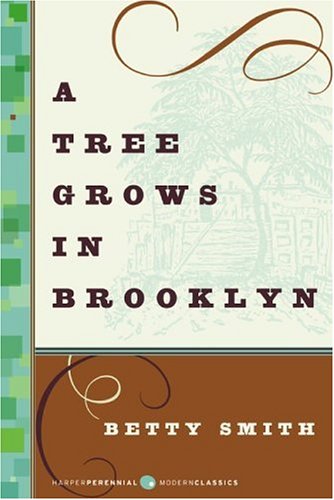
Pop Culture Homework Assignment #13: A Tree Grows in Brooklyn

I'm curious about the process by which we've decided which books are taught in high school English. I'm sure the teacher has some input, but from what I've heard, there isn't a lot of variability. When I tell people about the essays I had to write about The Scarlet Letter and Animal Farm, I can be reasonably sure of a sympathetic audience that had to go through the same thing. Once I graduated, it occurred to me that while Parkway South gave me a perfectly decent education, I should seek out books considered classics that I never got around to in the classroom. It's kind of the whole point of the Pop Culture Homework Project!

By doing this, I've discovered books that are wild, books that are wonderful, and books that are disappointing. But so far, I haven't caught up with a book that has really taken my breath away. Until now!

When Betty Smith's novel, A Tree Grows in Brooklyn, was published in 1943, it was an immediate best seller. Since then, it's been adapted into a movie (1945), a Broadway musical (1951), and a made-for-TV movie (1974). And I knew absolutely nothing about it but the title. The book begins in 1912, and revolves around Francie Nolan, who at the beginning of the story is an eleven-year-old girl living in the Williamsburg section of Brooklyn, New York. Nowadays, we think of Williamsburg as a cradle of wealthy hipsters and helicopter parents, but in 1912, it was stacked with tenement houses for the city's poor. The Nolans are among these poor, and while they aspire to a better life, they often go to bed with empty bellies.


It's tough to describe the "plot" of this novel, because it's a slice-of-life book. It may sound boring to hear that it deals with Francie's efforts to deal with events as everyday as trying to win a prize from the local candy store or how terrible her uncle is at relating to his horse. But just as the lives lived in The Up Series are about a collection of the little things, rather than just reporting on the highlights and lowlights, this book is much more than the sum of its parts.

Clearly, it's very autobiographical, but by making it fictional, Smith was able to get into more characters' heads than just Francie's. Everyone in the family is a well-rounded character, from her no-nonsense mother to her remorseful, alcoholic father to the kind, slutty aunt desperate for a child to raise. Nobody is wholly good or wholly bad. They're, you know, human. The book speaks frankly about Francie's romantic and sexual curiosity, something I found pretty shocking for a book written in the '40s.

Despite its slow pace, I couldn't put this book down; it's easy to see why it caught on with the public so quickly. Francie is enchanting in her normalcy, and the book she inhabits is rich and evocative. Far from romanticizing poverty like SOME things I could mention, the novel deals with the Nolans' money woes practically, without ever becoming a depressing slog.

So, it's time for a shake-up in American high school English classes. Teachers, take note. Why not teach this hopeful-yet-realistic novel that encompasses themes from poverty to the challenges of public education to economic exploitation to love? It's a hell of a lot better than that Heart of Darknesss crap.

A Tree Grows in Brooklyn: A
0

Pop Culture Homework Assignment #12: The Fault in Our Stars

I am not a book hipster. Or at least, I don't think I'm a book hipster. That is to say, I don't dislike popular books just because they're popular. I admit that I don't get the acclaim that a lot of heralded authors get (Jonathan Franzen springs to mind), but I try to give everything a fair shot. In reading glowing articles about John Green's 2012 smash hit, The Fault in Our Stars, I did worry about its popularity. A little nagging voice in my head told me that it would be the book equivalent of a Hallmark Card or a Lifetime Original Movie about cancer.

I did my best to ignore that voice, put myself on the waiting list at the library, and in the meantime, avoided absolutely everything having to do with the movie. I wanted to be sure and experience this in the same way the other first-time readers did. I managed to stay unspoiled, and after a lengthy wait, finally worked my way to the top of the list.

The Fault in Our Stars is told from the point-of-view of Hazel, a sixteen-year-old girl with terminal lung cancer. She has to navigate not only the obvious health problems her disease brings, but the societal problems of being a kid living on borrowed time. When she meets fellow cancer sufferer Augustus, they instantly connect. Since he's in remission, their relationship is fraught with her fears that she's adding another heart to be broken when she succumbs to the cancer, but he's persistent.

They bond over a book and the reclusive author who wrote it, making plans to go overseas to speak with him. Nothing turns out the way they expect, and soon they have to contend with problems much more dire than a mean old alcoholic author.


Make no mistake, this is a textbook tearjerker, but thankfully, it's not exploitative. Hazel's inner monologue is very relatable, with understandable mixtures of guilt and hope and fear and love and lust and resignation. Far from coming off as three-hankie melodrama, all of the characters' feelings are discussed openly, frankly, and honestly.

If I have to fault to book for anything, it's for Hazel and Augustus' hyper-intelligence. They're both far smarter and emotionally mature than any real teenager ever could be; it's almost as if their disease feels bad for them, and has compensated for all of their failing organs by supercharging their brains and souls.

That's a minor complaint, though. Overall, I really enjoyed the thoughtful, quiet nature of this book, and wound up liking far more than I thought I was going to. Sometimes, the Pop Culture Homework Project confirms the initial biases that kept me away from a popular title in the first place. But books like these are why I keep it going. Because sometimes, I really did miss something special.

The Fault in Our Stars: A-
0

Pop Culture Homework Assignment #11: The Warriors

Like I stated long ago, the main reason that the Pop Culture Homework Project exists is to fill in the gaps of my cultural history, so that I can see what all the fuss was about. There are a few other reasons, too. I want to be able to knowledgeably contribute as much as the general public to conversations about movies/books/TV/games that became a phenomenon. And of course, it'd be nice to get modern references that call back to old favorites. I can't tell you how many times I've heard some permutation of "Waaaaaariors....come out and plaaaaaaaaay!" as a jokey way of calling someone out. It pops up everywhere! And yet, I'd never managed to watch the movie that inspired this homage, 1979's The Warriors.

I knew a little bit going in. I knew that it was about gangs. I knew that it's a cult favorite. I knew that Lynne Thigpen and the guy from Xanadu are in it. And I knew that line. That's about it. It's a very strange movie. New York City is controlled by a couple dozen gangs, who have split up territory to control. Tension runs high between the gangs, so Cyrus, the leader of the most powerful one, calls everyone together to call a truce. Everyone's in favor of this except Luther (fittingly of the Rogues gang), who assassinates Cyrus and pins the crime on the Warriors. The rest of the movie involves the Warriors trying to get back to their safe territory of Coney Island while all the other gangs (plus police, for good measure) attempt to kill them.


It's a very video-gamey premise, which is one of the things I liked about it: In each new location, a new gang pops up, and the Warriors must somehow escape and move on to the next "stage". Along the way, Mercy (a hanger-on of a low ranked gang) decides she likes the Warriors' style, and becomes enamored of Swan, played by Michael Beck (the aforementioned guy from Xanadu). She tags along, and the two develop a romantic relationship, even as the Warriors fight off gangs like dudes dressed in baseball uniforms and an all-female gang that seduces before they attack. It sounds a bit silly and juvenile, which it is. But it's also extremely entertaining. There's even a subtle, poignant scene, in which Swan and Mercy observe happy couples out on the town. There's an awkward silence, and when Mercy moves to smooth her hair, Swan wordlessly stops her to indicate that she's just as good as any girl with a corsage. Lynne Thigpen is also wonderful, as she always is. All you see of her is her lips - she plays a DJ who serves as a sort of narrator and who continually encourages the gangs to rub out the Warriors.

Apparently, there was some actual gang violence and vandalism surrounding its theatrical release, which no doubt contributes to its cult reputation today. Also, I should mention that the version I could get from Netflix is a 2005 re-edited director's cut, which added comic book style transitions between scenes. It worked for me, and I'm assuming it's not a huge change from the original version people saw in the theater. Overall, I'm really glad I caught up on this one; I can see why it was so popular. For a lot of the Pop Culture Homework Project entries, once I complete the assignment, I feel like I don't need to revisit the work again. But when it comes to The Warriors, I can easily envision having friends over for a movie night rewatch. It's a fun movie that deserves its place in the cultural zeitgeist.

The Warriors: B+
0

Pop Culture Homework Assignment #10: Night of the Comet

You know what the best motivator for finally catching up on my Pop Culture Homework is? A notification from Netflix that something is about to expire. Something will be sitting on the list for months and months, to the point that I might not ever get to it, when suddenly, someone tells me I only have a week left, and I immediately start to carve out time to watch it. Pavlov's dog would be proud. One of these hurry-up notifications came the other day, and is what finally got me to settle in for the 1984 cult classic Night of the Comet.

Some preliminary work needed to be done. I knew that this was classified as a horror movie, so I fired off a tweet to the illustrious Hardcover Honey (AKA - my sister) for a report on how gory I could expect this thing to be. I remembered that it was a favorite of hers when she was younger, and figured she'd know if I could handle it or not. She scoffed, and told me that I'd be fine. No exploding skulls or stray viscera to worry about, here. A grim evening of terrible weather arrived a few days later, and I figured this was the moment to take advantage of a good doomsday flick.

I tend to like disaster movies and end-of-the-world stories, provided they're done well; my copy of The Stand has permanent oil spots from my thumbing through it so often. Night of the Comet is in the same vein. Some catastrophe has wiped out the majority of the world's population (in this case, the titular comet), and the remaining survivors struggle to adapt to the new world and the other people in it. The movie's protagonists are a pair of teenaged sisters, Reggie (Catherine Mary Stewart) and Sam (Kelli Maroney). Anyone who misses the big comet show and is protected by a layer of steel lives on, so Reggie is spared by having sex with her boyfriend in a projection room, and Sam by spending the night in a garden shed after getting punched by her stepmother. No, really!

People out in the open are turned to dust, but those who had minimal protection go through a more protracted downturn, marked by some mild zombie-ism. After Reggie's boyfriend is eaten by one of these skin-munchers, she and Sam head for the local radio station, where they meet another survivor, Hector (Robert Beltran). From there, the three of them face off against hungry zombies and evil scientists eager to drain their blood in order to find a cure for impending zombification.


Let's get two quick things out of the way. One, this is a very '80s movie. The clothes, the movie, the slang... All of it brings back fond memories of Lite-Brites and DangerMouse cartoons. There's even a shopping montage, because end-of-the-world be damned, this is an '80s movie, and OF COURSE THERE'S A SHOPPING MONTAGE. Secondly, you should know that everyone in this movie is an idiot. The heroes? Idiots. The villains? Idiots. The side-characters? Idiots. Surprisingly, the characters' idiocy detracted very little from the fun. That's probably because every niggling little thing that's wrong with this movie is counter-acted by the one thing it did very right.

This is a horror movie made in the '80s featuring female characters with actual agency. That's a deceptively simple idea, but it kept striking me over and over how refreshing it was to see a movie from this time period revolve around two girls navigating the apocalypse by being capable. Neither of them breaks down into hysterics. Neither of them goes running for a man to solve all her problems. When Reggie's boyfriend is eaten, she does not cower in a corner; she takes out the zombie with a wrench. I stand by my claim that both sisters are idiots, but at least they're idiots with senses of self-preservation, who clearly love each other and want to protect the other from harm.

I'm not quite sure what made this film catch on, and why it's considered a cult classic. It's a fairly simple story, with none of the gore that made the slashers of the '80s so popular. That said, I can certainly think of less deserving titles to become cherished. It's a silly movie, but at least it's silly and fun. It was, like, totally awesome! Oh, gag me with a spoon! I've become infected with '80s slang! Radical!

Night of the Comet: B+
0

Pop Culture Homework Assignment #9: Anna Karenina

When tackling gaps in my cultural history for this Homework Project, I should ideally consume the original work as it was intended. I was able to get the source material for things like Wuthering Heights and South Pacific, for instance. But other times, there's nothing to be done but to experience a work through an adaptation. I've never seen 1776 on stage, and likely never will. Today's assignment is the latter situation. I would love to have the time and concentration necessary to reading Leo Tolstoy's novel Anna Karenina, but I've been swamped lately, and had to settle for watching the 2012 movie, instead.

I knew a few things going in. I knew it involved a doomed love affair. I knew that it involved suicide-by-train. And I knew that the movie won an Oscar for the costumes, and was nominated for cinematography and production design as well. So, I was in for a visual treat. I've been told that the book can be intimidatingly dense (even a slog at times), and worried that even cut down to film length, it would be a stifling, dry movie. The Netflix disc sat on my bookshelf, unwatched for weeks. Finally, I couldn't put it off any longer, and watched it on an appropriately cold, bleak evening.

For those not familiar with the story, here it is in a nutshell: Anna Karenina (Keira Knightly) is married to a noble, but stodgy Russian government official (Jude Law). She meets military officer Count Vronsky (Aaron Taylor-Johnson), and the two are immediately drawn to one another. Anna gets pregnant, and though her husband attempts to save her from ruin, her destructive love for Vronsky ultimately drives Karenin to seek divorce, dooming Anna's social position and limiting her contact with her existing child. She's ostracized from society, she's intensely jealous of any interaction Vronsky has with other women, and faced with what she sees as an impossible situation, she throws herself under a train. There are also a couple of side-plots, one involving Anna's lascivious brother and his long-suffering wife, and one about the agrarian worker Levin and his efforts to woo a high-society woman.


For such a tortured, moody story, the movie is quite propulsive, and moves along at a good clip. It certainly deserved all that awards chatter about the costume and set design; this film is gorgeous. One neat thing about it is that it's set as if the story were taking place as a play - several scenes are set on the stage of a theater with no audience. It certainly fits to present such a melodrama as a theatrical presentation, even if the characters open a door on stage to find a real-life snowfield. It was a smart visual choice, and really helped engage me with the characters.

The back third, though, is a bit of an effort. Having established all the characters' motivations, a lot of time is spent reiterating Anna's tantrums and her subsequent entreaties for forgiveness. On the one hand, it helps explain how both Karenin and Vronsky get increasingly fed up with her. On the other, we the audience are getting just as exasperated. By the time she throws herself under the train, I was thinking "God, finally." The side-plots are mostly well-done, though the stakes of the Levin story don't reach the heights the filmmakers would have liked. Man likes woman. Man asks woman to marry him. Woman puts him off for a while, then says yes. The end. The actors did their best with such thin material, and if you'll forgive me for being a bit shallow, was helped by the fact that Domhnall Gleeson looked goooooood.

Ultimately, I'm glad I watched it. Does seeing the movie (even if I had watched a more faithful adaptation) take the place of reading the novel? Absolutely not. But the purpose of the Pop Culture Homework Project is to get a working understanding of the things everyone else already knows about, and on that front, this film succeeded admirably.

Anna Karenina: B-
2

Pop Culture Homework Assignment #8: South Pacific

After being casually dismissive of an entire era of musical theater during the last assignment, it may seem strange that I'd choose to throw myself right back into it for this one. This is where circumstance comes in. It was a lovely summer evening to hang out at the Muny. A friend I don't get to see much was going to see South Pacific there. And he had an extra ticket. Voila!

I knew very little about this show going in. I was aware of its existence, of course, and am naturally familiar with songs like "I'm Gonna Wash That Man Right Outta My Hair" and "Some Enchanted Evening", since they have filtered down into popular consciousness. But as far as plot and such goes, I went in blind. It's actually a really progressive show, given that it was first produced in 1949. Rodgers and Hammerstein wove two stories about interracial love into the show, one that is stymied by internal prejudice, and one that is beset by fears about societal rejection. Another very refreshing thing about this show is that the characters have no problem voicing their feelings. I don't mind the "I must keep this secret from so-and-so" trope if it's used well (and sparingly), but it's gotten a little tiring to see a story's main conflict revolve around a problem that wouldn't exist if people just sat down and had a five-minute conversation. Not so in South Pacific. If someone's in love, they say so. If someone's angry, they say so. If someone would like to use a burgeoning romantic relationship to obtain valuable espionage information, they say so. If someone has done something in the past that they're not particularly proud of, they admit it up front. I very much enjoyed that aspect of the show.


Unfortunately, I also enjoy things like tying up loose ends and good pacing, both of which South Pacific botches. Both of these problems are most evident in the story arc of the marine Lt. Joseph Cable and Liat, a young Tonkinese woman. Brought together by Liat's mother, the two of them fall in love and have sex almost instantly. I think literally forty seconds pass between their introduction and their Love For the Ages is consummated. Romeo and Juliet would take a look at these two and be, like, "Whoa, slow down, Trigger." Later, after Cable refuses to marry Liat, he goes on a dangerous military mission, during which he is killed. Liat and her mother, not knowing this, approach the show's main character (Nellie), and tell her that Liat insists on marrying Cable. Nellie says "there, there" and leads Liat off-stage. And that's it. That's the entire resolution to the major secondary story of the show. That abruptness of both beginning and end was very off-putting.

The main story (that of Nellie and plantation owner Emile de Becque) makes more sense, but brings to light the other issue with South Pacific. You know the famous songs I brought up before? They're great, as are a few of the others ("There Is Nothing Like a Dame", "Honey Bun", and "I'm in Love with a Wonderful Guy" are particularly good). But that's five songs in a pretty damn long show. There are vast stretches that are pretty uninspired, and tunes that are supposed to pack an emotional wallop ("Bali Ha'i", "Younger Than Springtime", "Happy Talk") left me cold.

I'm really glad I saw this show. Not because it's a fantastic work of art - I'd say that it's not great, but it's inoffensive and has charming bright spots. But like all Pop Culture Homework Projects, it gave me a better sense of the type of entertainment people have flocked to over the decades. You should have seen all the old ladies around me in the audience when Nellie launched into "I'm Gonna Wash That Man Right Outta My Hair". They began to sway in their seats, their eyes shining. It's obvious that South Pacific has been a huge influence on a generation of American culture, and even if it's not destined to have the same effect on me, I always find it heartwarming to watch people get so enthusiastic about their favorite works.

South Pacific: C+
1

Pop Culture Homework Assignment #7: 1776

I'm a big fan of musicals, but there seems to be a murky cutoff point in time between shows I generally like and shows I generally dislike. I really enjoy modern shows like Avenue Q and Wicked, and my admiration extends back to a lot of shows until we get to about 1975, or specifically, shows produced before A Chorus Line. Camelot? Bleh. Carousel? Bleh. Oklahoma? Bleh. Still, I at least gave those shows a chance. When it came to the 1969 show 1776, all that I knew about it was that it existed. Oh, and that it presumably dealt with the founding fathers, of course. I'd see it mentioned in pieces discussing shows of the era, but it somehow always got relegated to the back burner of my mind.

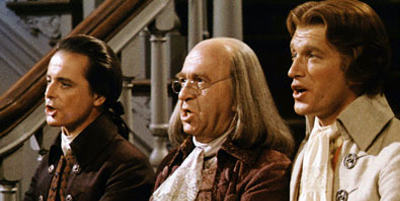
Until now! While hanging out with my friend Kyle the other night, we decided to watch the film version of the musical, released in 1972. How weird of them to make this movie in '72, with the bicentennial a mere four years away. What, they couldn't sit on it a little longer? As promised, it's a dramatization of the process of getting the Declaration of Independence written and signed, though the events are partially fictionalized. It focuses on John Adams as its protagonist. The role is taken on by original cast member William Daniels, who you'll know as KITT, Dr. Mark Craig, or Mr. Feeny, depending on what age group you're in. The only other actor you're likely to recognize is Blythe Danner as a Martha Jefferson who's wholly interested in banging her husband as much as possible.


This was a supremely weird movie. Given that it's a musical, there are obscenely long stretches of time with no songs whatsoever. Normally that would be a complaint, but since the music in 1776 solidly fits into that pre-1975 bleh period, I wound up being okay with it. These songs are not good, though "But, Mr. Adams" is a pleasant exception. The acting is mostly overwrought and hammy, although I must admit that Howard Da Silva made a highly entertaining Benjamin Franklin. You'd think that a movie with below-average acting and below-average music would mean that I didn't like it, and yet I found myself pretty riveted. In looking up information about the film, I ran across this review from Vincent Canby of the New York Times, which sums it up better than I ever could:

"The music is resolutely unmemorable. The lyrics sound as if they'd been written by someone high on root beer, and the book is familiar history — compressed here, stretched there — that has been gagged up and paced to Broadway's not inspiring standards. Yet Peter H. Hunt's screen version of 1776 insists on being so entertaining and, at times, even moving, that you might as well stop resisting it. This reaction, I suspect, represents a clear triumph of emotional associations over material. [It] is far from being a landmark of musical cinema, but it is the first film in my memory that comes close to treating seriously a magnificent chapter in the American history."

Yeah, that. Perhaps it was that achievement in directing that got 1776 nominated for a Golden Globe; it wound up deservedly losing to Cabaret. While I doubt I'd ever describe this film as "good", I'm guessing that I'll look back on it rather fondly, even given all its flaws. Maybe now that it's been completed as a homework assignment, it can slide over into the Guilty Pleasure category.

1776: C+
0

Pop Culture Homework Assignment #6: Christmas Vacation

I may be Jewish, but I'm not immune to the impulse to watch entertaining Christmas movies when the holiday rolls around. I don't really bother with It's A Wonderful Life much anymore, but I'll always be in the mood for A Christmas Story. And I suppose Die Hard counts as a Christmas movie, right? I'll go ahead and decree that it is. For some reason, National Lampoon's Christmas Vacation has always just slipped through the cracks. It's certainly hallowed by both Christmas movie fans and National Lampoon fans, so I'm not sure why it took me this long to watch it, but I finally plopped down and gave it a whirl.

One of the inherent dangers of the Pop Culture Homework Project is having to live up to the widespread stamp of approval that society has given a particular work. Since I'm arriving late to the experience, a beloved property can turn out to be disappointing. I'm afraid that's pretty much what happened here.


There's just too much history weighing down on this movie. We're pretty much past the era of comedies composed of nothing but pratfalls. We know what Chevy Chase and Randy Quaid have turned out to be like. It's fun to see kid versions of Johnny Galecki and Juliette Lewis, but their parts are pretty minor. I get the feeling that if I'd seen this movie in 1989 when it was released, I'd be a bigger fan of it. As it is, I feel like it's a so-so fluff movie that doesn't really deserve its place in the Christmas Canon.

Christmas Vacation: C
0

Pop Culture Homework Assignment #5: Wuthering Heights

The copy of Wuthering Heights I got from the library is bound in a pale pink cover, with the image of a placid, porcelain beauty on the front. Its back cover includes a quote that reads: "My greatest thought in living is Heathcliff. If all else perished, and he remained, I should still continue to be... Nelly, I am Heathcliff! He's always, always in my mind: not as a pleasure...but as my own being."

Makes it sound so sweeping and romantic, doesn't it? If you knew nothing about Emily Bronte's Wuthering Heights, which I didn't, you'd assume as I did that it falls into the same category of those other drawing room romances, with hopeful young Englishwomen plotting their schemes for an advantageous marriage. That's not a criticism. I happen to love that style of literature; Charlotte Bronte and Jane Austen both hold places of pride on my bookshelf. So, being a fan of the style, I figured it was time to fill in this glaring omission in my reading background, and plunged in. Wow, you people had me fooled.


Wuthering Heights is emphatically not a shy little romance, but a dark, twisted novel of despair and selfishness and petty revenge. None of Austen's heroines would last a week in this setting, where brutal physical fights and constant emotional manipulation are the norms, and the best thing any character can hope for is to be ignored. Rather than a love that conquers the ages, the relationship between Heathcliff and Catherine is a mutually destructive dirty bomb that poisons and destroys all around them, and that's how they like it. Both of them are completely egocentric monsters, devoid of compassion for anyone but themselves and each other. If they existed today, they'd have a reality show on E!

It's a very claustrophobic story. The characters are sealed off in two neighboring country houses, and hardly anyone can either penetrate that isolation from the outside, or escape it from within. Who wouldn't go crazy? Heathcliff overhears part of a conversation that would seem to suggest Catherine feels herself too above him to consider marriage, and that one little event sets off a chain of hate and recrimination that will eventually decimate half a dozen lives.

This novel is incredibly pessimistic of human nature. Aside from the Heathcliff/Catherine debacle, there is plenty of child abuse, hypocritical religion, and psychological warfare running rampant through its pages. And if all of this sounds like a complaint, it's not. This book kind of blew me away, mostly because its plot was so unexpectedly bleak. Though nine-tenths of it is morose, Bronte made sure to end on a hopeful note, with the promise that the cycle of pain and heartache endured by this family for two generations may finally be coming to a close.

So, by all means, read it. But the next time someone tries to lump this book in the same category with Sense and Sensibility, don't fall for it like I did. The characters of Wuthering Heights would sooner grab your head and smack it on the fireplace than escort you to the local ball for tea and cakes.

Wuthering Heights: B
0

Pop Culture Homework Assignment #4: A Game of Thrones

When it comes to the fantasy genre, I'm halfway between casual fan and hardcore geek. I can't quote Tolkien by heart, but love fantasy MMORPGs. I've never picked up a Wheel of Time book, but am timidly exploring Magic: The Gathering. I'm like the Persephone of the fantasy world, spending half my year happily nerding out, and half my year scratching my head over the properties coming out of Comic-Con.

Since there seems to be an endless stream of books and games in the fantasy realm these days, I'm not surprised that the Game of Thrones series didn't catch my attention until it became a big deal in the mainstream. I probably wouldn't have given it a second glance if it hadn't caught on with such a wide segment of pop culture enthusiasts. But it did, so it had to go on the Pop Culture Homework Project list. The HBO series looks fascinating, but my aversion to gory movies and television means I'll probably never see it, so I turned to the book that inspired the widespread popularity in the first place.


Because the story is so sprawling, trying to describe the plot with any amount of specificity would take forever. Simply put, there are multiple lords, all of whom serve under a high king. Not everyone likes their monarch, though, and there are several characters who plot to overthrow him, and that includes the greedy, power-hungry family he's married into. This first book mostly revolves around three families: The noble Starks, the deposed Targaryens, and the aforementioned greedy, power-hungry Lannisters. You won't want for detail in this book. Every family has loads of members, and there are scores of tertiary characters as well, all with their own motives.

As with many things I'm catching up to late, I had a few issues figuring out just exactly why something is as popular as it is. Not that this book was bad; I enjoyed it, and am already on to the second book in the series. Still, nothing really stood out as special enough to capture the nation's collective interest. An interesting story is still an interesting story, but there wasn't anything new here. In fact, I think I counted at least four lines that appear word-for-word in I, Claudius.

Perhaps this series uses the first book to lay groundwork that pays off later, much like the first season of Mad Men. If not, I may never understand why this book caught fire in the popular consciousness, but as far as mega-violent, epic series go, you could do a whole lot worse.

A Game of Thrones: B
0

Pop Culture Homework Assignment #3: The Wire

Television over the past few years has been an embarrassment of riches. There have been plenty of crappy shows not worth a second glance, but my current problem isn't that I can't find anything good to watch; it's that there's so much I want to catch up on, certain types of shows have to get put on the back burner. Deep, complex dramas are generally the first to get benched. That's not because I don't like them - if they're done well, there's no better kind of show.

The commitment they take can lead to some issues, though. I don't get HBO. I don't have a DVR. If I happen to miss an episode of a serialized drama, I could potentially be hosed for the remainder of the season. Sometimes, the best method is to wait for the season to end, and then shotgun all of the episodes over a concentrated time-span. It frees up your schedule and keeps details fresh in your memory. The only real hitches are the efforts to remain spoiler-free and the fact that you can't discuss episodes after you see them, because they've long since been dissected by others.

There are many shows like this that I've been meaning to get into. Mad Men was the first experiment, and went swimmingly. I decided it was time to get into another involved drama that everyone praises to the heavens, but that I hadn't seen a single minute of: The Wire. I literally could not find a person who had seen this show and didn't like it. A coworker of mine owns the DVDs, and enthusiastically loaned the first season to me.


This inaugural season focuses on the drug trade in Baltimore and the police's efforts to stem it. Far from being a black-and-white portrayal of good and bad guys, every one of the multitude of characters is a shade of gray. The drug dealers can be compassionate. The cops can be greedy. The show doesn't shy away from the way that drug addiction tears a community apart, or the way that society tries to combat these problems can be weighed down into irrelevance by bureaucracy and corruption. Those sorts of plotlines can make a show depressing in a hurry, but The Wire also has its moments of levity. As with most dramas of this type, aspects of the story unfold over many episodes, and there are about a thousand characters to keep track of, so this is a show that requires your full attention. I was happy to give it. Though I was worried this show wouldn't live up to its hype, it met every expectation I had for it, and I'm already looking forward to tearing into Season 2.

The Wire - Season 1: A-
0

Pop Culture Homework Assignment #2: The Room

Normally, my intent is to seek out entertainment I think I'll like. Something that's been well-reviewed or is massively popular with critics I tend to agree with or has gotten good word-of-mouth from my friends.

Not always, though. In this case, I went hunting for something I knew in advance was going to be crap. It started with podcasts: They'd play weird sound drops that were funny, but didn't seem to make any sense. They'd reference not being so confused about something since The Room. Articles popped up about people attending screenings to yell at the screen, a la Rocky Horror Picture Show. Books are being written about it. One day, I heard a How Did This Get Made? episode that attempted to explain the whole phenomenon. But no amount of description could do the job. Clearly, the consensus that The Room is one of the worst movies of the modern era had solidified, and I had missed the memo.

So, I rented it. I fear I'll fall even shorter at attempting to describe what can loosely be defined as a "plot". Suffice it to say that director Tommy Wiseau stars as good-guy Johnny, whose fiancee Lisa becomes bored with him, and seduces his best friend. Johnny finds out, Lisa dumps him, and Johnny kills himself. The end. All of this is padded out by about seventy-six tertiary and quaternary characters introducing subplots that appear out of nowhere, are discussed for thirty seconds, and disappear, unresolved. Por ejemplo:


That's it. The house? Never mentioned again. The brother? Never mentioned again. The BREAST CANCER? Never mentioned again. And that was forty seconds of film. Imagine things like that popping up all over the place for an hour and a half. I suppose those unresolved plotlines are broken up by the five interminable sex scenes, which go on and on and on and on and on and on forever, to increasingly horrible music.

This movie seems like visitors from Mars came down, were given a brief summation of how movies work, and gave it their best shot. No, you know what? Strike that. This movie is like visitors from Mars came down and were given a brief summation of how humans interact, and gave it their best shot:


It's a gloriously terrible film. It's nice to finally be in on the joke, of course, but I'm mostly glad I was able to revel in a movie that will give others a run for their money in Best of the Worst.

The Room (as a movie): F
The Room (as an experience): B+
0

Pop Culture Homework Assignment #1: A Wrinkle in Time

I figured the best way to kick off both the Pop Culture Homework Project and the new year would be to do something simple.  And what could be simpler than a children's book?


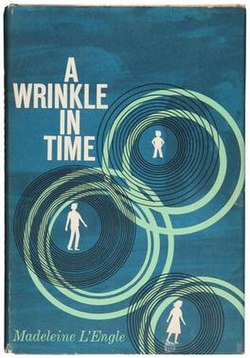
I've always been an avid reader, but when I first picked up A Wrinkle in Time in about seventh grade, I found it intolerably boring, and tossed it aside after only a few chapters. My classmates didn't seem to have this problem, and so I'm one of the few people who have managed to make it to adulthood without being able to look back on this novel fondly as a cherished childhood memory. I can't understand why, because I've always loved stories of children who journey to a magical land to face down challenges and demons, like Alice's Adventures in Wonderland, The Phantom Tollbooth, etc.

So, how did it fare now that I've finally read it? Well, it's not entirely fair for me to judge it, because I'll never be able to see it through the eyes of a kid. It's like those people who wait until they're 32 to watch The Goonies, and then can't understand what all the fuss is about. Perhaps that explains why I found this book underwhelming.

The main characters are essentially yanked along on their journey by other entities, rather than setting out with a plan of their own. All the challenges are faced by staring deeply into one another's eyes and yelling. The character of The Happy Medium is introduced, only to play absolutely no real part in the events. The religious themes, so nimbly hidden in The Chronicles of Narnia such that I didn't notice them until years later, are overt and clumsy here.

These may be unfair complaints, akin to playing art critic to the kindergarten fingerpainting a proud parent has displayed on the family refrigerator. Still, I can't say that I regret missing out on this book. Either I've missed my window of opportunity for loving it, or my seventh-grade-self was on to something.

A Wrinkle in Time: C+
0

The Pop Culture Homework Project

No matter how faithful a consumer of pop culture you are, there are going to be things that struck a chord with the public at large that simply passed you by. Perhaps you always meant to read that book, but never got around to it. Maybe you were too young to fully appreciate that movie, and never gave it a second chance.

The Pop Culture Homework Project is a way of attempting to fill some of these gaps in my cultural history. I'll no doubt find that I love some of the works in these assignments as much as everyone else did. I'll probably discover that I gave up on or skipped something for a very good reason, and will not sign off on the public's stamp of approval.


This exercise is not about tracking down hidden gems that were overlooked. This is all about finally experiencing something that most people have already gotten under their belts. Really, the biggest potential risk is that I'll wind up loving something and want to spread the word, and then be embarrassed to remember that the word has been spread for many decades. In any event, this kind of homework sure beats the pants off Calculus.
 
Copyright © Slice of Lime