0

There's Gold in Them Thar Hills!

It's time to begin looking back over the blog posts of 2014 and compiling the year-end lists, which I always enjoy. One conspicuous absence from these retrospectives is the world of music. As I've probably mentioned a handful of times, I just don't spend enough time in the world of new music to put together a reliable list, preferring instead to just listen to knowledgeable friends' recommendations. The only exception was Suzanne Vega's new album, which is terrific.

Well, let's add one more album to the list of music that brought me joy in 2014, even if it was actually released in 2013. I was piggybacking on Spotify... What's that? You don't know what piggybacking is? That's when you sneakily drop in to just listen to the tracks that the sidebar mentions that your friends are listening to. Anyhow, I was piggybacking on Spotify one day, when a particular song caught my attention. After it was over, I backed up and listened to it again. And again. After that, I decided to take a stroll through the entire album, and was happy to hear that this wasn't just a one-track wonder.

The album I'm referring to is Black Sun, from a band called Gold Fields. The song that so captured my heart is "Thunder", which easily claimed the title of my favorite song of 2014 (again, the song was released in 2013, but this is year that it ruled the airwaves of my mind). As with a lot of my favorite songs, it seems to occupy that nebulous middle ground between the deep layering of indie music and the upbeat tempo of pop.

Sometimes indie music can be too dour and often produces tracks that fall into the category I call wall-of-sound. And pop music is often shallow and overly fluffy, relying on a catchy beat and ignoring exploration of anything interesting either musically or lyrically. The songs I like the best somehow find a way to straddle that line, retaining the thoughtfulness of indie with the catchiness of pop.


Give "Thunder" a listen, and tell me if you understand what I mean. Arrgh, this is why I don't write about music! It's too hard to describe! While the rest of the album didn't match the heights that "Thunder" achieved for me, a handful of them came close. I really like the jaunty romanticism of "Treehouse" as well (ignore the dumb video, and just listen), and "Closest I Could Get" has a haunting, ethereal quality I enjoy.

Really, the entire album is a great find, and while I wish I could take the credit for discovering it, I owe it all to the friends I follow on Spotify. Speaking of which, I'd better get back to stalking their playlists. I need to "find" an album for next year, too.

Black Sun: A
0

Unsupervised

For someone who's made the life choice to not have children, I sure do read a lot of books that are either written about or written for young 'uns. I haven't really explored why this is. Maybe it's cause YA or stories revolving around kids' problems are easy lifts, and if I'm feeling lazy, it doesn't take a lot of brain power to process stories like Harry Potter. That's not to say these books are inherently inferior; just not as densely layered. It's like how watching Scrubs requires a lot less attention than watching Mad Men, though they're both good shows.

Anyhoo, all this is to say that I've just finished up another batch of kid-centric books. Their premises are nowhere near similar. One doesn't get much more ribald than admiring a girl's eyebrows, while another describes getting banged by a big dick in exhaustive detail. One of them takes the view that children's points of view are often neglected to the detriment of society, while another assumes that most kids, if left unchecked, are basically assholes. The one thing that all three of these books do have in common is that they're pretty damned good. Oh, and another similarity - I actually managed to read them in the year they were published! That's a rare accomplishment for me, being a wait-in-line-at-the-library type of fellow.

First up was Spoiled Brats, the new short story collection from Simon Rich. Rich's previous book made the #2 spot on my favorite books of last year, so this one had some big shoes to fill. Where The Last Girlfriend on Earth focused on love stories, Spoiled Brats steps onto the minefield of modern parenting, which is ripe for satire: Parents be crazy. The style is similar in this book, veering wildly in perspective. One story is told from the point of view of a elementary school class hamster, trying to protect his children from the carelessness and neglect of the students. One is told by a chimp who feels superior to his poo-flinging parents after being noticed by a researcher. Helicopter parents explain the attention their gifted child needs and don't understand why him being a demonic force from hell should prevent him from getting the best education. All of the stories are clever and funny, and I'd recommend them to anyone who interacts with children or parents, not just those with kids themselves. It doesn't really attempt to do anything beyond what The Last Girlfriend on Earth did, and as such, it didn't have as much of an impact on me, but it was still a good read, and the two books would make a great companion set.

Speaking of sets, I also got my hands on Shouldn't You Be In School?, which is Book #3 in the All the Wrong Questions series by Lemony Snicket. I enjoyed both Book #1 and Book #2, though I'm noticing the usual trend of series becoming less engaging over time. My review could basically be repeated word-for-word from last time: "If the book suffers from anything, it's a lack of novelty. It's a great story, but not all that different from Book #1. I'm still as interested as ever in this storyline, though, and am eagerly anticipating Book #3". Just replace that #1 with a #2, and that #3 with a #4. I will say that Shouldn't You Be In School? does ramp up the action somewhat, which injected some much-needed urgency. Lemony and his friends in Stain'd-by-the-Sea are solidifying their group into the VFD we know and love in the Series of Unfortunate Events books, and must contend with missing schoolchildren, a rash of arson, and the ever-mysterious Ellington Feint. At this point, the series has become pleasant and comforting in its wittiness and character exploration, which is plenty of reason to continue with it.

Speaking of pleasant and comforting... Wait, that's a terrible transition. Because while I plenty enjoyed Caitlin Moran's How to Build a Girl, "pleasant" and "comforting" are two adjectives that belong nowhere near it.


I'm always trying to read books from different authorial perspectives, and this one was singled out in reviews for being a strong one for a young female character with actual sexual agency. It certainly follows through on that promise. It's about Johanna Morrigan, a teenaged girl in 1990s England, whose family subsists entirely on her father's disability check. She's smart as a whip, but doesn't have a lot of outlets to develop her promise. She also suffers from all the self-esteem issues that plagued us all as teens, but which are especially damaging to girls. Desperate to prevent her family's tenuous income from crumbling (and equally desperate to get laid), she puts on the front of a seen-it-all, world weary music journalist, and scores a position writing poison pen reviews of shitty bands. The effort of maintaining her front (and throwing herself at any available man) consumes her, which leads to all sorts of bad decisions, both professional and personal. Though I didn't particularly care for the coming-of-age-through-shifting-music-tastes trope, I realize that's a matter of taste, rather than any problems in the writing. Moran makes Johanna relatable and likeable, even as she's shoplifting eyeliner or masturbating while her brother sleeps next to her, and that's a difficult trick to pull off.

Spoiled Brats: B+
Shouldn't You Be In School?: B
How to Build a Girl: B+
0

(H)ath Not An Audience Eyes?

When a drama is bad, it's unsettling enough. But is there anything more tortuous than a bad comedy? I don't know if I'm alone in feeling this way, but I'd rather watch five disappointing "regular" movies than one underwhelming farce. This is usually where word-of-mouth is an enormous help. There are plenty of movies that looked good on paper, but once they were met with a collective shrug (or worse), I could be relatively confident that I should take a pass.

There is no such luxury when it comes to the ABC project, though! This experience is all about diving in, and hoping that I discover some hidden gems. Hamlet 2 (2008) looked like it might have some promise in that department. The premise of a disgraced drama teacher putting on his own wackadoo high school play is perfect. Steve Coogan plays that teacher, who is told that due to funding cuts, he'll be losing his job at the end of the year. He's been producing awful film-to-stage adaptations, and between the end of his job on the horizon and a newly-populated-with-underpriveleged-Latino-students-for-no-reason class, he decides there couldn't be a better time to put on an original work. "Hamlet 2" will be a musical, time-travel extravaganza, and will right all the depressing wrongs of the original play (and will help him work out his daddy issues in the meantime). Again, sounds fun, right?


It just doesn't work. There are flashes of fun here and there, but the majority of the movie is just Coogan behaving like an oaf, with no real wit or bite to the satire. The community gets whipped up into a frenzy of religious protestors and free speech advocates, but it's all the same jokes you've heard before. Catherine Keener is relegated to another thankless, pointless role as the shrewish wife. There is one bright spot in Elisabeth Shue, who plays herself (but an Elisabeth Shue who gave up acting to become a fertility clinic nurse in Tuscon, Arizona, which...what?).

It's not a terrible movie by any stretch. It's just lackluster. But when it comes to lackluster comedy, you'll find yourself pining for a good ol' fashioned tragedy in a hurry.

Hamlet 2: C+
0

Pretty Pretty Princess

Towards the end of the year, I have a very patchwork system for watching movies. Movies are not only starting to gather awards and awards buzz, but December is when all the "Best of..." lists start appearing. That means it's time to play catch-up with all the noteworthy films that have come out over the past year. Some, I can grab on Netflix. Some, I decide I can safely skip. And some demand that I rush right out to the theater. So when I saw one trusted critic's Top 25 of 2014, I went ahead and added everything that looked interesting to my queue. Except one. One was not only unavailable to add, but looked so pretty that I immediately began casting around for local theater screenings. Naturally, the good ol' Tivoli came through, and before I knew it, I was eyeballs-deep in The Tale of Princess Kaguya.

This is a Studio Ghibli production; it comes from the same people that made The Secret World of Arietty and Princess Mononoke. Unlike those two movies, though, I not only saw The Tale of Princess Kaguya on the big screen, but I saw it in the original Japanese, with English subtitles.

The story follows a fairly standard fairy tale structure. A poor farmer stumbles across a magical baby, born of a bamboo stalk in the forest. He and his wife are overjoyed to adopt her, even as she grows to young womanhood at an extremely rapid pace. The farmer interprets other signs to mean that his mission in life is to get his daughter into the highest echelons of society, and begins to work towards that goal. He succeeds in moving his family from poverty to wealth, but the rules and regulations that restrict noble young ladies cause Princess Kaguya to bristle. She has no interest in being silent and still and marrying a boring nobleman. She misses the days of her freedom, and calls out to the heavens to help her. As in most fairy tales, it's a rash wish, and one that she'll come to regret.


Story-wise, this movie is very languid. It's very slow and thoughtful, and you can feel every one of its 137 minutes. That's neither a compliment nor a criticism. At times, I felt like it should be moving along at a brisker pace, the way Spirited Away and Howl's Moving Castle did. But at other times, I was really enchanted by the lyrical stillness of the scene. And if there's one aspect of the movie that is just about flawless, it would be the visuals. Studio Ghibli has reliably terrific animation, but in this film, the animation is not only beautiful, but inventive. There are scenes wherein the emotion of the characters actually changes how they are drawn. Raw hysteria and panic are rendered in rough, almost abstract outlines of people and surroundings, while calmer introspection allows for scenes drawn in vibrant color and minute detail.

The Tale of Princess Kaguya is already racking up acclaim, beating out all other animated movies for critics groups in Los Angeles and Boston. If I were rating movies on visuals alone, I would enthusiastically throw my support behind it as well. Ultimately, the story was just a little too meandering for me to be that effusive, but if you're looking to feast your eyes on a work of incomparable beauty, this should definitely be on your list.

The Tale of Princess Kaguya: B
0

Thanksgiving Tune-Ups and the Parsley Dispute

Four Courses Podcast - Episode 11

We've already had our first blustery snow days blow through, so it's almost officially time to bid adieu to the best season of the year. Before we do, though, we had one more harvest feast to celebrate - a little thing called Thanksgiving. We're at the peak of the food year, and Episode 11 has arrived just in time.


Topics include Fast Eddie's Bon Air, the essentials for both a home bar and a well-equipped herb/spice rack, and food trends that are dead and gone. We close with a nod to Thanksgiving by soliciting recommendations on how to update the use of cranberries. They're due for a change. Please enjoy, and feel free to drop a line to fourcoursespodcast@gmail.com with any questions, comments, feedback, or suggestions!
0

All the Single Ladies

Once upon a time, I promised to watch a show. And then I didn't. There are a number of reasons for this: The list of other shows to catch up on got too long. I was getting my period television fix from Downton Abbey. Childbirth and midwifery are not among the topics that generally appeal to me very much.

But finally, a block of viewing time miraculously opened up, so thanks so much to the new fall season for being 90% terrible! I decided to finally give Call the Midwife the chance I had promised it, so while I was a little bit trepidatious, I settled in to begin Season 1. This show is, in a word, riveting. I was expecting it to be pretty good, but I never thought it would be gripping. The stories in each episode are pretty simple, and most of them revolve around the same issue: how to care for people who cannot care for themselves. But every episode in this first season found a fresh way to look at the problems of pregnancy and sickness in 1950s London.

Pregnancy and labor are usually handled in a standard, three-screams-and-here's-your-baby. It's almost become an off-handed plot point in most shows. Call the Midwife re-establishes the stakes, not only in setting the show in a time where giving birth was a great deal more fraught than it is today, but by exploring the issues surrounding troublesome births, from socioeconomic status to religion to mental health. The cast is top-notch (both the group of nurses and the nuns they reside with). If there's any failing, it's that the main character is a bit of blank slate, and most of the interest comes from the people orbiting around her. I'm very much looking forward to starting Season 2, and since I've already name-checked Downton Abbey, let's hope that unlike that show, Call the Midwife doesn't fall into a sophomore slump.


Moving from terrific to terrific-er, Netflix finally released Season 2 of Miss Fisher's Murder Mysteries for instant streaming. As you'll recall, I gushed about Season 1, and was over the moon when more episodes became available. My only worry was that they wouldn't be able to keep up the charm and interest, now that a pattern had been established.

No worries, mate! If anything, Season 2 is even better. Phryne is still fun-loving (in many, many senses of the word "fun"), but her relationship with Detective-Inspector Robinson is slowly, but surely developing in a very organic way. In a parallel track, Deputy Collins and Dot are also cementing their relationship, and finding as many obstacles. Even the case-of-the-week, which would naturally be the most rote aspect of a murder mystery procedural, has taken a big step up. Many disparate worlds are explored: Phryne insinuates her way into the realms of high fashion, street-racing, archaeology, sideshow boxing, and more. And the Christmas special finale ramps the situation up even higher, as the main characters are not just investigating murder, but are targets as well. It was a fantastic season, and I'm already champing at the bit for the next one.

Call the Midwife - Season 1: A-
Miss Fisher's Murder Mysteries - Season 2: A
0

Magical Mystery Tour

The real world is boring! And when it's not being boring, it's being sad and depressing. It's no wonder readers and audiences are constantly looking to jump into fictional worlds of wonder, be they utopian, dystopian, or something in-between. Of course, authors are members of this unfortunate real world, so they have varying amounts of success in capturing the feel of the supernatural. On that note, I just finished two books that attempt this jump. One did a great job; one... One was not so great.

The first was Susanna Clarke's 2004 novel, Jonathan Strange & Mr. Norrell. An admission up front: I had read the synopsis of this book (Two sparring magicians become rivals in their shared goal of bringing magic back to the forefront of 19th-century English society) and thought it sounded like a quick, fun read. While it was plenty of fun, quick it was not. This sucker is 782 pages long.

That's not a knock against it. Reading this book made me feel like I was researching a historical document, which is exactly the feel it was going for. It's tough for a book to put you into the state of mind of another time period, the way TV does all the time, but this one almost makes the reader believe we took it off the shelf to peruse in the 1800s.

After it fades from the mainstream, both the stuffy Mr. Norrell and his apprentice, the younger, more adventurous Mr. Strange, want magic to be a big part of English society again. But while Mr. Norrell trades in theory and research, Mr. Strange wants to use magic more practically, applying it to the English war effort against the French. The relationship between them frays and snaps, and they both begin to meddle with power they cannot control. Other characters are soon drawn into their webs, and magic's reputation with the ruling class becomes the least important problem that the magicians must contend with.

Though it was a long haul, I enjoyed this book, and wonder if it would have made as much of an impression if it were shorter. I do think it's one of those books that has aspects that may be especially appealing to me, and that I shouldn't widely recommend. But if you like the idea of magic being an almost everyday subject, as dense and as full of historical research as astronomy, by all means, give it a go.


I rejoined the modern era with The Three, a 2014 novel by Sarah Lotz. It's arranged as snippets of interviews, basically copying the format of World War Z. The interviews tell the story of Black Thursday, on which four separate planes from four separate airlines on four separate points of the globe all crash. Terrorism is ruled out as the cause, but in an even stranger turn of events, on three of the flights, a lone child survives.

The world immediately begins to try and puzzle out the cause and the meaning of all this. The usual crazy theories about aliens and conspiracies swirl through the internet. The explanation that amasses the most support, though, is that the three children are harbingers of the upcoming apocalypse, and a tide of religious fervor sweeps in.

Pretty cool premise, right? As with a lot of disappointing books, though, a pretty cool premise doesn't mean much if you botch the execution. Most of the book is build-up. A lot of chapters end with statements like "I didn't know that it was the last time I'd ever talk to him," or "Of course, when they found out what happened later, everything changed." Build-up like that has to lead to something pretty explosive. And it doesn't; it ends with a shrug.

This could have been a good book if it had built to the revelation that there were completely rational explanations for the crashes, and all the hysteria was misguided. This could have been a good book if it had built to the revelation that the children who survived really were otherworldly visitors or the messengers of an angry God, and the characters had to deal with the fallout from that. Instead, after all this building and building, the book ends with a smarmy "Gotcha!" and walks away - the equivalent of a twenty-minute joke where the punchline is that there is no punchline.

Jonathan Strange & Mr. Norrell: B
The Three: C-
0

The Sound of Silence

Amidst the birthday and other holiday gatherings that pop up on my Facebook invite page, once in a while I'll spot an interesting public event. One of my friends is an organist, and recently, he posted about the local organist group's fundraiser, which immediately caught my attention. And not just because of the promised wine and hors d'oeuvre! The group was also screening a silent movie, for which there would be live organist accompaniment, to approximate the movie-going experience back in the day.

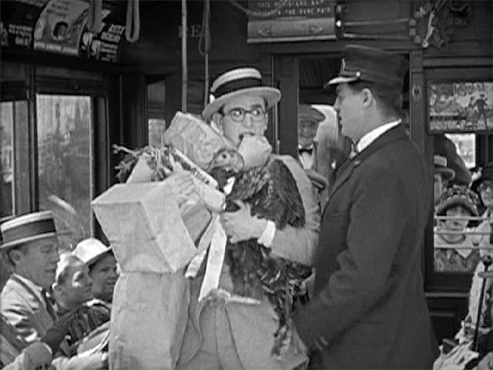
The movie chosen was 1924's Hot Water, starring Harold Lloyd, who was immensely popular at the time. In introducing the movie, the event organizer told the audience a fun fact I'd never heard before: That organists were free to improvise whatever music they felt complemented the film. I'd always assumed that silent movies came with a pre-written score for the organist to play. I had no idea that every individual organist was given free rein to interpret and adapt the themes. Just as a thought experiment, imagine what it would be like if every theater showing Gravity had had a different score. Amazing.


The movie itself was a gas. See, I'm already speaking as if I live in 1924! I was half-expecting it to be a bit stale and dated, but it genuinely made me laugh. It's only about an hour long, and though there's a thin storyline running throughout, it's mostly an excuse to present a few vignettes. Lloyd plays a young husband just trying to lead a normal, pleasant life with his new bride. Mishaps and hijinks ensue. First, there's the matter of trying to get home on the trolley with an armful of groceries, including -- wait for it -- a live turkey. Then, it's time for a relaxing drive in the new car with his wife, her mother and brother, and...some pre-Dennis the Menace neighbor brat, maybe? At dinner, Lloyd accidentally chloroforms his mother-and-law, and mistakenly believes that he has killed her. So, lots of pratfalls and misunderstanding abound, and happily, they all easily translate to modern sensibilities (except maybe bottles of chloroform lying around the house).

The organist was great, too; all of his music choices fit the mood of the movie perfectly. Honestly, I mostly went to this event out of curiosity. It seemed like a different way to see a movie, and I wanted to at least make an attempt at experiencing what it was like to go to the movies in the '20s. I wasn't really expecting to get a kick out of the movie itself, and I've never been happier to be wrong. It wound up being a really fun film and a fun evening, and as a bonus, I got to see it in an era with internet and plentiful sushi restaurants.

Hot Water: B+
0

Won't Somebody Think of the Children?

Hi! I'm 37 years old! OK, now that that's out of the way, let's talk about kids' movies! Animation has been having a very good time of it, lately. Though it can be difficult to balance story, comedy, and appealing to audience members of all ages, studios have pretty much been knocking it out of the park lately, give or take a Cars 2. I mean, I see a lot of movies over the course of a year, many of which are designed to win awards, and what winds up landing in my list of favorites? Animated kids' movies. I just saw another trio of contenders, so how did they stack up? Let's find out!

Big Hero 6

Big Hero 6 is the latest from Disney, who has taken to copying a lot from the Pixar playbook. That's not a complaint; I've been enjoying the new style quite a bit. In this newest movie, protagonist Hiro is a precocious, science-minded kid in the near-future city of San Fransokyo. His older brother is also an engineer, and when he's killed in an explosion (not really a spoiler - it happens towards the beginning, and c'mon: Mufasa, Anna and Elsa's parents, Nemo's mom, Tiana's father, etc. etc. etc. etc. etc.), Hiro takes up his project, an inflatable health-care companion named Baymax. Hiro's own inventions come back to haunt him, so he teams up with his brother's colleagues and Baymax to combat the new threat to the city.

Good stuff first. This movie is gorgeous, and the design of San Fransokyo is a flawless, futuristic meld of American and Japanese culture (I do wonder what happened in World History to create this city. Someone get on a novelization of that). The characters are nicely diverse. Baymax is adorable, and I'll be imitating his fist bump for days. Also, I should mention that Feast, the short in front of the movie, was terrific (though I don't know if I'd think as highly of it if it didn't feature a Boston Terrier. Buuuuuuuuuh cuuuuuuuuute.) All in all, it was a very sweet movie.


That said, when stacked up against its siblings (Tangled, Wreck-It Ralph, Frozen), it suffers a bit by comparison. Every story beat is overly telegraphed. Though Baymax is a memorable character, none of the humans can claim the same. I'm glad I saw it, but unlike those other movies I just mentioned, I doubt I'll ever have the urge to revisit it.

Cloudy With a Chance of Meatballs 2

Next up was this 2013 sequel to 2009's Cloudy With a Chance of Meatballs. I was surprised by how much I liked the first one, but even given that, I was a little skeptical of the sequel. I shouldn't have been. This time, Flint Lockwood and pals are tasked with dealing with the malfunctioning FLDSMDFR (Flint Lockwood's Diatonic Super Mutating Dynamic Food Replicator, silly), which is spitting out food/animal hybrids. I cannot believe how many pure, deep-seated belly laughs this movie got out of me. And it wasn't just the low-hanging fruit (*rimshot*) of food puns! There are actual, story-based jokes that had me almost falling off the couch. The story is a little predictable and thin, but it almost doesn't matter. I got a huge kick out of this one.

The Boxtrolls

Finally, I took in this past September's The Boxtrolls, which was cleverly deployed before Big Hero 6 could steal its thunder. Of the three movies, this one was the weakest, though still not bad. It involves a cheese-obsessed society of humans who lives above a sewer-dwelling race of trolls who are named after whatever product is advertised on the cardboard boxes they wear. The two groups are bitter enemies, but things begin to change when a boy raised by the trolls attempts to reconcile them, with the help of a strong-willed girl who wants nothing more than to see scenes of grim carnage. The stop-motion animation style of this one was extremely well done. In fact, I have zero issues with anything about the technical design of this movie, which is beautiful. But the characters are not particularly engaging, the story is not particularly intriguing, and despite a few shining jokes, the humor is pretty lacking. It sure did make me want to tear into a big pile of cheese, though.

Big Hero 6: B
Cloudy With a Chance of Meatballs 2: B+
The Boxtrolls: B-
0

Sugar Imperatives and the Shortbread Concierge

Four Courses Podcast - Episode 10

Autumn! Autumn! Autumn! It's passing by too quickly. While we've still got it in our clutches, we've packed another episode full of seasonal goodness, so put on a sweater and go listen to Episode 10.


Topics include "No Menu Monday" at Home Wine Kitchen, a new semi-regular segment about our favorite drinks of the season, the majesty of soups and stews, and the food traditions of Halloween. Dibs on all the Mr. Goodbar! We close with Kyle's advice on stocking up the freezer for the cold months ahead, and given the sudden shift in temperature, it has come none too soon. Please enjoy, and feel free to drop a line to fourcoursespodcast@gmail.com with any questions, comments, feedback, or suggestions!
 
Copyright © Slice of Lime